In many modern cultures it is widely accepted, if not expected, for teenagers to begin dating relatively freely. This was not always the case; in the 17th and 18th centuries, teenage courtship was unheard of. Dating was strictly controlled by parents, with rules based on religion and culture.
"Frontier" or "back-country" people were of Scottish-Irish decent, and carried many of their beliefs in regards to courtship with them. Men would "abduct" a woman of their choice, typically with her consent. Men and his court of friends would band together and steal the bride, the ceremony being a boisterous dancing-drinking celebration.
Much stricter Puritans, considered marriage not a union of religious significance or of love, but of a mutually beneficial "civil contract". They utilized such tools as "courting sticks," used for private conversations between couples, and "bundling boards" to separate suitors when they sleep. Ceremonies consisted of civil, quiet, dinners, in contrast to the wild parties of the back-country community.
The Quakers, not unlike the Puritans, were also very strict in terms of marriage and courtship. Before a Quaker couple could marry, they would need the approval of both their parents and the entire community as well as undergo a sixteen step courtship phase. Despite this long and arduous process, Quaker women would sometimes reject men at the last minute.
Courtship among South societies also included ceremonies. African American slaves practiced the marriage rite of "jumping the broomstick", a ritual in which the bride and groom jump over a broomstick to seal their union.
In Virginia, marriage was not based on love, but were still considered sacred unions. Since marriage also involved the union of properties, the parents of the couple were involved in many negotiations.
By Grace M. and Casey F.
Showing posts with label Colonial Courtship. Show all posts
Showing posts with label Colonial Courtship. Show all posts
Thursday, September 17, 2009

Courtship, Colonial Style
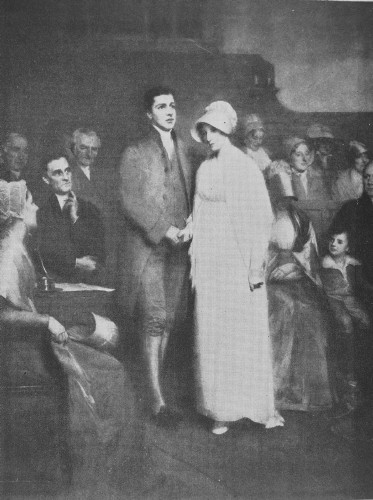
The many different colonies formed between 1630 and 1763 had vastly different cultures, representing their different ancestry and lifestyles. Perhaps one of the clearest examples of their diversity is their various paths to marriage. Although all of these people limited dating to young adults and grown men and women, their courting varied greatly.
In the rugged backcountry, a man would "steal" a wife from her family (who knew about it before), as per tradition. These mainly Scot-Irish colonists had based theirconcept on an "abduction" ceremony of the past. The following wedding would be filled with wild drinking and dancing as the bride, groom, and their friends celebrated. Almost every person eneded up married, and the age to marry was far younger, with little difference between the age of brides and grooms.
On the other hand, in Virginia (one of the earliest colonies), marriage was a sacred and religious union. Love was unnecessary; on the other hand, the exchange of property and money between the parents took high priority. These marriages were far more civilized than the backcountry parties; the new couples had to keep up countless social graces in their new lives together. Oddly, although nearly all women married, one-fourth of all men never did. In addition, first-cousin marraiges and large age differences (10+ years) were allowed. Divorce was illegal in Virginian colonies.
Puritans took marriage as neither religious or sacred, but a civil contract. The strict customs prevented courting between a couple without the supervision of their parents. In addition, to dissuade pre-marital sexual relations, the Purtitans adapted interesting practices-- such as a "courting stick" tube to allow two loves to talk between rooms, and a "bundling board" placed between two lovers in bed. Before the actual marriages, leaders of the meeting house were allowed to voice any opinions. Following the test was a simple civil ceremony and dinner, neither with the grace of Virginia or the celebration of the backcountry. Most men and women married, and their was little age difference. Unlike with the Virginians, first cousin marriages were discouraged. Divorce, suprisingly, was legal.
The Quakers followed a very communalistic lifestyle; as a result, their marriages needed the permissions of the entire community. To gain the approval of large group, the lovers needed to complete a long, 16-step courtship. Even with this all out of the way, many Quaker women were known to reject their men. Almost a fifth of the women were single, and first-cousin marriages were forbidden. Divorce was strictly illegal.
In the case of slaves in the South, many of the customs followed by white colonists in other cultures would be impossible. Instead, African slaves took on their own customs, some based on those of Africa and some innovated to fit their harsh conditions. For example, their was a custom of plantation slave couples "jumping the broom stick" to complete their marriage.
These different customs are only of the sample of the many conventions-- simple or complicated, religious or civil, graceful or rowdy-- that young couples underwent to hold each others hand in marriage.
Wednesday, September 2, 2009
Colonial Courtship
Although all processes of colonial courtship involved only adults, different community traditions caused variations of courtship and marriage customs. Community traditions were often affected by the colonists’ cultural backgrounds, including religion and geographic location prior to immigration.
The majority of colonists in the frontier or backcountry colonies originated from Scotland and Ireland. As a result, their practices were based on the Scottish-Irish tradition of "abducting" the bride (who had previously given consent). The groom and his friends would steal the bride away from her home and to the ceremony. These frontier and backcountry weddings were quite festive and accompanied with drinking and dancing.

Southern slaves followed their own courtship customs as well. One was the "jumping the broomstick" ceremony. The bride and groom would jump over a broomstick to symbolize their procession from courtship to marriage.
Love was not often considered an important criterion in marriages, and courtship in Virginia was no exception. Although marriage was considered a sacred union, it was also more of a business transaction of properties than the pairing of soulmates. Consequently, parents were deeply involved in courtship to ensure the most fiscally secure marriage for their respective child.
-Noelle
Colonial Courtship
In the colonial age there were many ways to court a woman. The frontier or backcountry people had a custom to steal their wife before the wedding. But this could only be done by the woman's consent. After her consent the groom would come with his friends and take her. The bride and groom were usually around the same age.
The Puritans on the other hand had a really strict marriage arrangements. It was more of a civil contract than a religious union. The couple had to be supervised together at all times by a parent. They were allowed to speak to each other through a long tube. The Puritans also had a strange practice of allowing the couple to sleep together in the same bedroom, but with a long board between them. This was called bundling. Before they were allowed to get married their marriage had to be pass by the leaders. After that they were allowed to have a small quiet wedding. The Puritans allowed people to get divorces if they wanted to.
African slaves on the other had a really simple marriage ceremony of jumping the broomstick.
For Quaker couples instead it was more difficult to get married, because they needed not only the permission of their parents but also the permission of the whole Quaker community.
They had to go through several steps before they could get married, but most women rejected the man at the last second. Due to this 16 percent of the women were single of the age of 50.
One of the restrictions on Quaker marriages were that could not marry your first cousin.
The Virginia marriages on the other hand allowed the first cousin marriages. The marriages were often made by the parents. For this reason not the love was required but the property of the man or the woman. 25 percent of males never married and if they did, they mostly were about 10 years older than the woman.
Marriages in the colonial age were a lot difficult than today.
- Yasmeen & Laura -
Subscribe to:
Posts (Atom)