Showing posts with label 1950s culture. Show all posts

Wednesday, March 24, 2010

1950s Culture

During the 1950s, World War II just ended, and Americans had to readjust to post-war life. The fear of another Great Depression and the fear of a nuclear war caused Americans to strive for conformity and economic security. This led to the American Dream, or the ideal way of living for the people in the 1950s.

The American Dream included things for people of all types. For men, it was ideal to get a white-collar job, or clerical, managerial, or professional occupations. Unlike blue-collar jobs, white-collar workers tended to work in sales and advertising. White-collar jobs also paid more. However, this financial security came with a price. Businesses do not like creative thinkers or rebels. This created a loss of individuality for individuals.

For women, the role of a homemaker and mother was glorified in the 1950s. It was the dream of many women to work at home and become the "keeper" of the family. However, this led to dissatisfaction among some women. The boredom of being at home and the lack of fulfillment in their lives caused more and more women to work outside of home. Even so, jobs for women outside of the house were limited to nursing, teaching, and office support. Women were also paid less for the same amount of work.

In addition to creating ideals for men and women, the 1950s introduced teenagers to the world. With the conformity of life and the increased usage of television, young adults deviated from the ways of their parents and formed a culture of their own. With icons like James Dean, Marlon Brando, and Elvis Presley, teenagers popularized rebelliousness, having fun, and rock 'n' roll.

Of course, culture of the 1950s could not have flourished without the use of cars. During this decade, the creation of new suburbs made owning a car a necessity. This caused the automotive industry to flourish, stimulating production and providing jobs in related areas. Drive-in movies, drive-thru franchises, restaurants, and shopping malls became popular. However, this automania was also deadly. Car accidents increased every year, and traffic jams raised stress levels. The necessity of cars also created a wider gap between the middle class and the poor.

The culture of the 1950s was influenced by the need for conformity and economic stability. This caused men to want white-collar jobs, women to want to become homemakers and mothers, and teenagers to rebel from the conformity that their parents liked. All this is supported and emphasized by the availability of automobiles.

- Angela

1950's Culture

The 1950's reflected a period of extreme conformity. Businesses such as McDonald's developed into franchises and conglomerates. Society became standardized, and with it the work became standardized. Individuality was repressed in face of economic advancement.

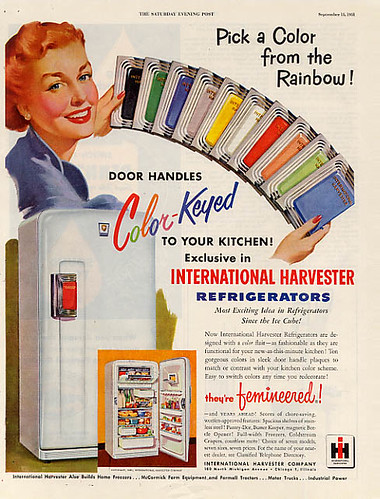
Consumerism also experienced an increase. Material goods became equated with success, and people bought hundreds of new products. Recreational items such as televisions, tape recorders, and record players were also popular; many tasks were being completed by electrical household appliances and Americans founds themselves with more and more leisure time.

Household appliances were not the only ubiquitous products. Automobiles suddenly became and available commodity when the war ended. The abundance of petroleum led to inexpensive and plentiful fuel for consumers. Conforming, suburban residents found themselves in need of a car to drive to their jobs in the cities.

But not all aspects of society had the opportunity to live like this. The mass movement of white Americans from the cities to the suburbs took economic resources away with them. The rural poor were forced to migrate to the inner cities. Most of those who were affected were minority groups.

-Grace Mi

Thursday, March 11, 2010

1950's Culture: Consumerism and Conformity


After the war, businesses expanded rapidly and the economy skyrocketed. Industrial jobs became less common, and more people worked in higher-paying jobs usually in sales or advertising. Franchises began popping up around the country- McDonald's, for example, was one of the most successful franchises of the time and today it is also the largest. The significance of these franchises was that they helped to standardize what people ate. The 50s was also a conformity movement, and in ways besides their diet, American lives were being more and more standardized. A loss of individuality had to be paid in exchange for economic advancement. In the business world, there was no room for creativity.

Another theme during the era was the exploding population, commonly called the "baby boom". When soldiers returned home, they settled into family life again. During the 50s, there was a large emphasis on marriage and family, especially for women. Men were back in the work force, and women became homemakers once again. The American dream of the 1950s was: single-family home in the suburbans, safe healthy environment for children with good schools nearby, and jolly neighbors all around. The dream house also had all the latest technology in household appliances, so that the woman who stayed at home all day would have to do less work and she could be happier and livelier. Less work meant more leisure time, and during the 50s Americans had more of that than ever before. With more vacation time, automobiles played a significant role in the 50's lifestyle. Now not just a commodity, cars even had their own style. Many of them were marketed for fashion and fun. With the automobile came drive-thru at franchises, and franchises meant consumerism. Buy, buy, buy became the mentality all around the media and at home.

Although the 1950's were all about conformity, youth rebelled stronger than ever. They shaped the pop-culture movement during this time: for the first time ever teens dressed differently from their parents and they listened to different music. Rock and roll started as a trend among youth but grew unto older generations as well. These youth moved on into the 60's to create the decade which became the rebuttal of the 50's: the era of non-conformity.

by Mingming